
The AI Danger Zone: Why General Models Fail on Financial Documents
General-purpose AI models can summarize documents and generate text with impressive fluency. But when extracting numbers from financial documents, our research reveals consistent failure patterns that make them risky for production use.
General-purpose AI models can summarize documents, answer questions, and generate text with impressive fluency. But when we test them on a specific task that matters in finance (extracting numbers from tables, PDFs, and scanned documents), our research team has found consistent failure patterns that make them risky for production use.
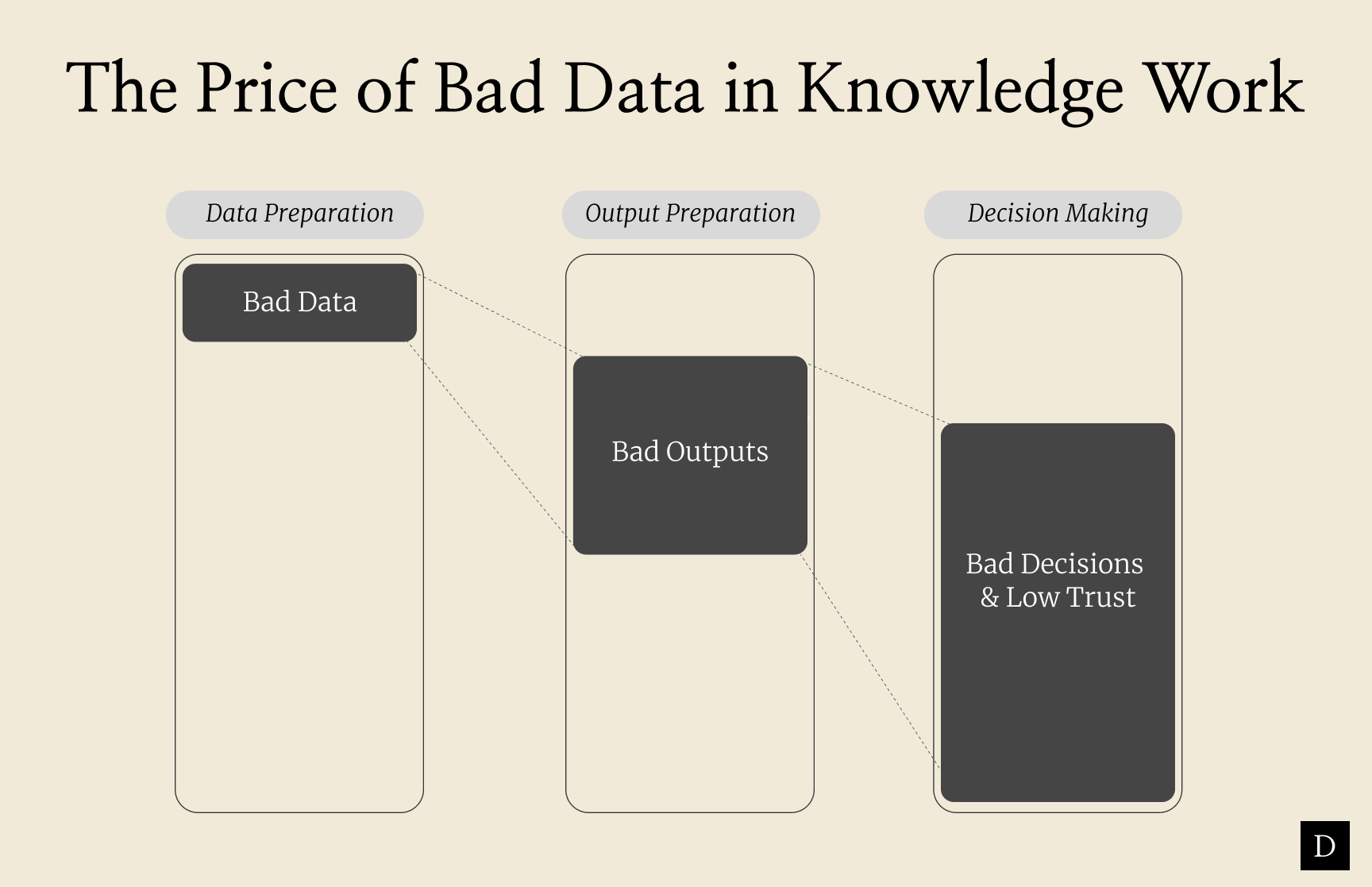
It's imperative to grasp the model's blind spots just as much as its strengths in order to prevent bad data from contaminating results and eroding trust in outputs.
This post shares preliminary findings from our ongoing research into why these failures happen, how often they occur, and what architectural approaches show promise in reducing them. We'll cover:
- The specific types of errors we're observing in controlled tests
- Why standard AI benchmarks miss these problems
- Early results from specialized architectures we're testing
- Open questions that still need answers
Our goal is transparency about both what we're learning and what we don't yet know. This is active research, not finished work.
Understanding Reliability Gaps in General-Purpose Models for Financial Documents
Model advancements have been exceptional. However, through controlled testing across frontier models, we've identified specific architectural limitations that make these systems unsuitable for production deployment in contexts where numerical accuracy carries regulatory or fiduciary consequences, and we've developed infrastructure approaches that begin to substantially reduce these failures.
The challenge emerges from how general models process visual information. Think of it like asking someone to read a contract through a frosted window. They might catch the general structure and main clauses, but critical details (decimal points, minus signs, footnote markers) blur or disappear entirely. The reader's fluency in legal language lets them produce a coherent summary, but that fluency masks where they're reconstructing details rather than reading them. In financial documents, those missed details often carry material semantic weight.

Therefore, it's imperative to grasp the model's blind spots just as much as its strengths to prevent bad data from contaminating results. We discuss more on this topic below.
Current State of Production Deployments
In today's financial workflows, general-purpose models handle many document tasks effectively: summarization, classification, basic data extraction from clean digital text. The failures we're focused on occur in a specific but common scenario: processing documents where critical financial data appears in image-embedded tables, scanned pages, or compressed formats. These aren't edge cases in finance. In fact, they're standard conditions for board materials, investor decks, historical filings, and third-party reports.
We have strong evidence that general architectures introduce systematic errors in these contexts, but importantly, we also see clear paths to mitigation through specialized preprocessing and multi-path validation. This is an engineering challenge we can address, not an inherent limitation of the technology.
Key Findings from Systematic Testing
Working with financial institutions processing real document pipelines, we built evaluation frameworks to measure failure modes quantitatively. We tested current frontier models (including GPT-5 and previous generations) against financial documents under realistic conditions.
To operationalize "reliability," we focused on extractable metrics: digit-level accuracy on numerical values, sign preservation on negative numbers, decimal precision maintenance, and structural alignment in tables. Using these metrics as proxies for production readiness, we found consistent failure patterns:
Resolution sensitivity: When we resampled clean financial tables, general models showed material digit-level error rates on numerical extractions, with no corresponding drop in confidence scores. That's undetectable during deployment.
Sign preservation failures: On scanned income statements with small fonts, minus sign dropout occurred frequently across tested models. The outputs appeared fluent; the signs simply vanished.
Structural misalignment: When we introduced minor gaussian blur to mimic typical loss when converting files the model became confused across the data. In gross margin tables, this systematically produced values hundreds of basis points from ground truth.
Calibration breakdown: Confidence scores showed near-zero correlation with actual accuracy on degraded inputs. Models that flagged uncertainty effectively on clean text showed false confidence on compressed financial tables.
As part of this work, we developed and tested a specialized architecture approach: text-first extraction with layout parsing, vision fallback only for image regions, and multi-path validation with arithmetic checks. In controlled evaluation, this reduced undetected errors significantly and we will publish these results soon. However, rare but significant failures remained, particularly on documents with complex layouts or degraded scan quality.
Why Standard Benchmarks Miss These Failures
Most vision-language model benchmarks evaluate on clean, well-formatted documents or test comprehension rather than extraction fidelity. Financial documents present specific challenges:
-
Text-image hybrid content: A single PDF may contain native text on some pages and embedded images on others. Uniform vision processing introduces unnecessary errors on text content while missing the need for specialized handling of image tables.
-
High-frequency visual features: Financial documents rely on thin rule lines, small typefaces, and subtle punctuation (minus signs, decimal points, superscripts) that carry critical semantic meaning. General vision encoders trade these high-frequency details for computational efficiency. This is a reasonable tradeoff in most contexts, but catastrophic in numerical extraction.
-
Calibration domains: Models trained for conversation or instruction-following develop confidence calibration for language generation, not visual extraction accuracy. When applied to document processing, those confidence scores become uninformative or misleading.
Knowing What the Model Doesn't Know Is Just as Important as Knowing What It Does
The goal is to protect user workflows from bad data that impedes on the efficiency gains we rely on AI for in the first place. Often times output is deemed to be of poor quality. This can often times be an illusion as the actual culprit is in fact much farther towards the beginning of the value chain: our data.
We've made meaningful progress, but significant work remains. Our text-first architecture with multi-path validation reduces failures substantially, though it introduces latency and cost tradeoffs that may not suit all applications. The approach also depends on accurate PDF structure parsing, which itself fails on malformed or heavily corrupted documents.
Looking ahead, we're focused on three research priorities:
Efficient hybrid processing: Our current text-first approach works but adds complexity. Can we develop smarter routing that maintains accuracy while reducing overhead?
Scalable evaluation frameworks: We need standardized benchmarks for financial document reliability that capture real failure modes. This requires collaboration across institutions to build shared ground truth datasets.
This isn't about whether general models are impressive (they demonstrably are). It's about matching capabilities to deployment requirements. Financial document processing sits at an intersection where general architectures show consistent limitations, and those limitations create material risk in production contexts.
We've focused on this problem for the past year and believe we have viable approaches, but there's substantial work ahead. Reliability in financial applications requires different validation standards than general-purpose tasks, and developing those standards must be a priority in an industry that relies on the highest levels of accuracy.